Pages

Wednesday, June 27, 2012

tarbiah zaatiyyah in action alahai

Dalam perjalanan pulang ke rumah seusai solat isya di masjid, sedar-sedar sahaja Scorpio sudah tinggi di dada langit. Orion sah-sah dah tenggelam. Anak bulan Syaaban pula dah tersangkut tinggi di menara masjid. Fuhh… cepat betul masa berlalu. Sehingga putaran alam pun aku sudah hilang arah.

Kadang-kadang, rasa bosan menyelubungi diri dek tiada stesen radio yang menggamit jiwa. Kalau dulu-dulu (zaman struggle Alevels), slot Late Night Love Song daripada Redfm yang sering dipilih, terutama sekali semasa membuat ulangkaji Further Maths (atau apa sahaja subjek yang bersifat kenomboran hehs). Haish… lagha sungguh.

Jadi, bila terkenangkan lagha yang kadang2 melampau, aku tukar stesen Ikimfm. Alahai, dua kali lima juga rupa-rupanya. Ditambah pula dengan suara deejay lelaki yang tak ubah seperti perempuan. Muntah hingus juga sekali-sekala. Maka, tinggallah KlasikNasional yang terkenal sebagai pemutar lagu-lagu klasik piring hitam sebagai pilihan neutral.

Meluangkan masa bersama-sama keluarga di depan televisyen pun boleh jadi bosan. Punya laa baanyaaaak saluran yang Astro Byond tawarkan, saluran 393 One HD juga yang adik-adik aku duk menggila. Naik stress dan tambah uban dah kepala aku dan abah aiyoyooo. Nasib baik aje aku tak terikut-ikut artis Korea, justeru, Alhamdulillah dijauhkan tuhan daripada menjadi pondan yang tak bermaruah.

Arakiannya, kepada semua teman di luar sana, terutamanya lepasan IB, Alevels, mahupun mana-mana ujian, jika anda semua senasib dengan saya (=bosan tak ada benda nak buat), saya menyeru jomlah kita sama-sama mengamalkan doa ini hehe...

oh, lupa bulan rejab dah habis hihi!

Digalakkan juga agar diperbanyak selawat ke atas junjungan Nabi Muhammad saw. Sabda baginda yang bermaksud “sesungguhnya rejab ialah bulan Allah, Syaaban ialah bulanku dan Ramadan ialah bulan umatku”.
Perlu diingat, keberkatan masa perlu dijaga kerana masa juga merupakan makhluk Allah. Kepado saeng2 (lebih kpado pringatae wak diri sndiri jugop bbena), wak ringae2 la tuboh gi ddenga ssejid. Dokpom, pderah mano2 ayat qur’ae hok tok ingat. jange pulok sapa kito immune nga bare2 molek. insyaAllah Allah yusahhilnaa.
*orang bukan Kelantan yang dapat 'translate' ayat atas ni memang aku respek ahh

Saturday, June 16, 2012

A-Levels...


…over. Yet the learning agenda does not.

                I was on cloud nine of course. It feels like having both honey chipotle’s fajitas  and Portobello mushrooms in mustard vinaigrette, with pico de gallo as the side dish, in a scenery overlooking lagoons like the one in Bintan. In a simpler term: I am relieved. Yeah that’s it.

                ‘Ala kulli haal, ujian kali ini agak getir dan menyeronokkan. Seronok sebab adanya pelerai stres seperti Euro 2012, hockey junior asia cup, piala sultan azlan shah, champions league, piala FA, piala Thomas, French open, formula 1 gp, Giro d’Italia, le tour de france, dan etcetera di kaca televisyen, justeru, menyebabkan sedikit kegetiran apabila secara tiba-tiba masa dirasakan sangat suntuk.

                Maka suasana di kolej menjadi semakin sunyi dan berjerebu. Sunyi (internal disutilities) sebab jumlah pelajar berkurangan, manakala jerebu (external disutilities) disebabkan oleh kebakaran hutan di Sumatera. [Lawak betul. Semalam ada orang datang cakap kat aku bahawa kebakaran hutan Lembah Beringinlah yang menyebabkan kejadian jerebu. -.-! (dasar budak bandar)]

                 Tinggal seminggu sahaja lagi untuk aku bermukim di kolej. Tinggal dua hari (secara sah di sisi undang2) untuk bermain air kolam. Tak tahu lah sempat atau tak nak improve sebab asyik2 10 lap je yg termampu. Tinggal beberapa hari saja lagi untuk bermain selipar dengan budak2 kolej. Tinggal beberapa hari saja lagi untuk lepak di café baru. Tinggal….

...tinggalkan kolej, which is the best thing to do. And write more about it in the near future as a remembrance I believe.

buah berangan kuih bahulu,
sering diidam si gadis perawan,
layangkan kenangan di angin lalu,
pudarlah dendam diingat jangan.

(aiyok teruk gila pantun aku sekarang, huhu~)

Sunday, April 29, 2012

KLIBF

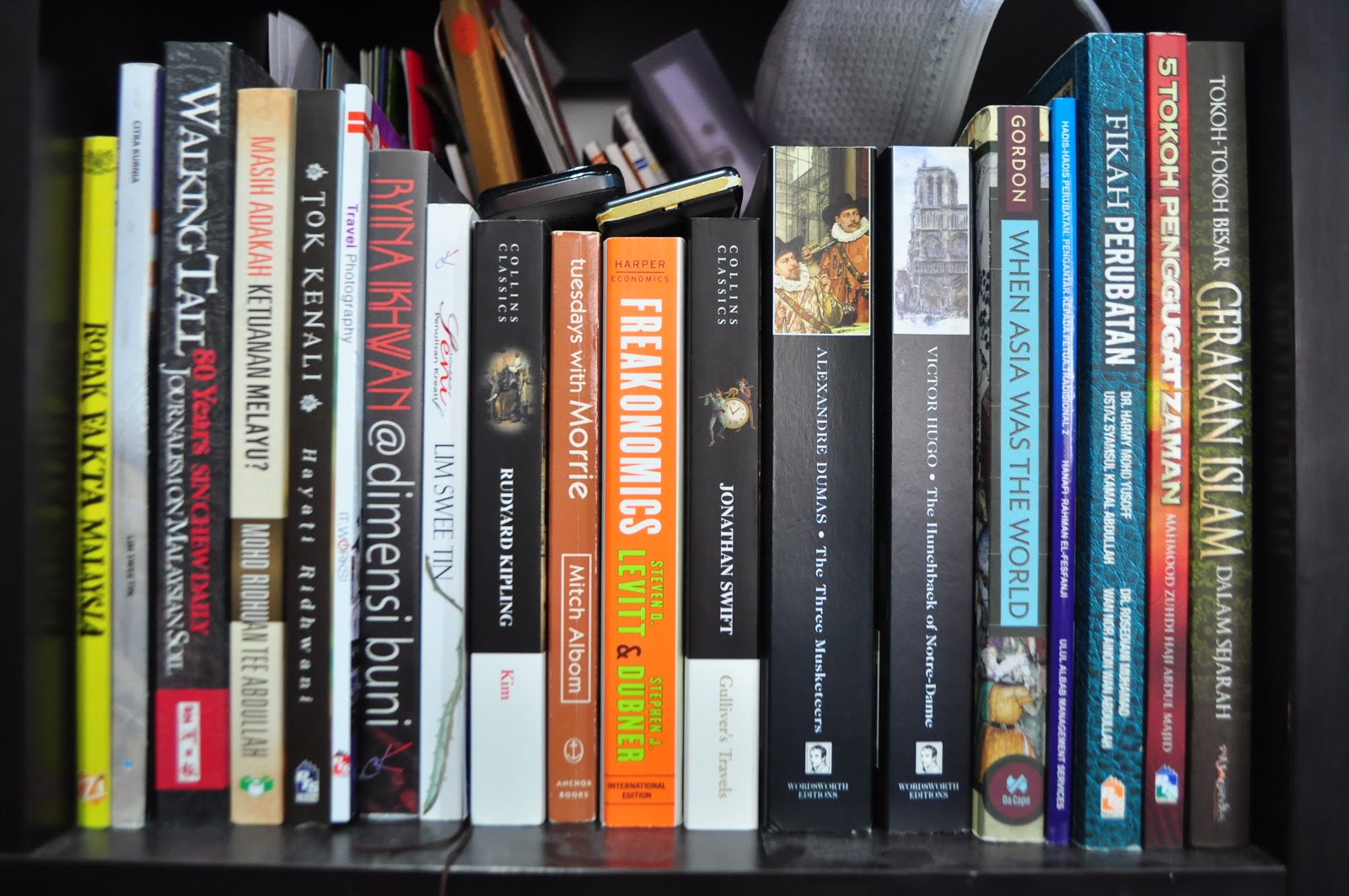
antara buku yang dibeli di pwtc

Salam semua!

Phew.. sebenarnya, aku tak sangka yang aku masih ada masa untuk mengemaskini blog ini. Walhal peperiksaan Alevel sudah berada di sekitar selekoh (baca: around the corner). Alhamdulillah kolej aku telah memberikan kami 'study leave' selama seminggu. Tetapi, keberadaan di rumah juga merupakan suatu penyeksaan... urghh.

Err.. jangan haraplah aku akan terperuk di bilik dengan buku pelajaran seperti liutaio yang membikin violin di ateliers cremona, lombardy (northern state of Italy), haha. Malah, masa nak tunggu abah fetch me di kolej jumaat lepas pun aku sempat panjat swimming pool dan beriadah barang se-lap dua.

Hari ini aku ke pesta buku Kuala Lumpur. Sebuah 'event' tradisi yang aku amalkan sedari kecil. Aku juga ada berhasrat ingin menghadiri pesta buku di Mesir. Kata orang, di sana lebih meriah. Apa-apa pun, kali ini banyak juga  buku yang sempat disambar sebab umi dan abah ikut sekali. Jadi, kami adik beradik jadi 'tukang tunjuk' lah nak itu nak ini pastu last2 umi abah yang bayar. Hehs.

Hari ini, segala-galanya tentang sastera dan budaya (tapi takde lah 100%). Tak sempat aku nak telek kategori2 buku yang lain sebab umi divert fokus kitorang adik beradik ke arah karya2 sasterawan dan bacaan2 bermutu yang lain. Terbatas lah juga pergerakanku. Ditambah lagi dengan umat yang gila ramai mak nak. Jadi, insyaAllah esok aku ke sana sekali lagi. Hari Isnin pagi2 tak ramai lah kot...

antara belian hasil baucar buku yang masih belum habis dibaca. =.=

Teringat aku pada suatu hari, murabbiku Ustaz Nizam ada berkata, "gunalah masa muda yang hengkorang ada sekarang ni untuk membaca. Baca, baca dan baca segala mak nenek khazanah ilmu sementara ada kesempatan. Nanti bila dah berkerja, komfemmm dah terlambat. Pagi keluar kerja, petang balik, riadah kalau masih larat, maghrib isya pergi surau dengar kuliah kalau masih ada kesedaran, balik surau pulak kena settle benda2 duniawi, pastu tidur."

"Itu belum dahsyat lagi kalau dah berkahwin," celah aku disusuli gelak ketawa.

Nevertheless, priorities must be set right. Kalau jauh tenggelam dalam buku2 sebelum exam, alamatnya cacing kepanasan lah nanti. Jadi, sempena exam Alevels yang mendatang (errr...?), dengan rendah hatinya aku nak pinta kemaafan daripada semua yang mengenali diri ini, dari hujung rambut sampai ke duli di bawah tapak kaki. Doakan kejayaan kami ya. Aku juga mendoakan kalian. =)

# i don't think that i will be updating new entries in the near future. this one might be the last for like... 2 months from now, i think (why think? haha). Anyways,

best of luck and bittaufiq wannajah to my peer friends, to those who are doing IB in KMB, yang kat KMS pun sama, to seniors who are struggling with their semester/final exams in universities, n to those who are not aforementioned, fa izaa 'azamta fatawakkal 'ala Allah~ 


Sunday, April 15, 2012

Naik Broga ; berwudhu' dan pakai selipar jepun


Excuse me for the random post title, ahax!
I shall write in length later, but not this time
that laziness occupied me (hence explained my randomness).

Now may i ask,
what criterion separates the line between a scrapbook and a photo album?
if the question is inapprehensible, then i might ask further;
'what differentiates flickr, photobucket, and fotopages?'

got knocked?
or the thoughts aren't just there?
well i rest my case.... =)
but maybe...
my move to FotograFIFI could give a clue to the question. hihi.
and whether you agree to disagree with the premise,
or begging to differ some opinions point out by others,
both scrapbook and photo album upholds the same idea
that a picture does tell us thousand words within.

jadi, kepada insan2 di luar sana yang masih belum faham,
visi fotografi adalah untuk mendapatkan makna yang tersirat,
bukan semata-mata kerana imej tu cantik atau tak.
(jenuh gila aku nak explain kat orang pasal menatang ni arghh!!!)

umpamanya...
anda tidak perlu mengejar
darjah sri tri buana manjakani chula sakti 
yang membawa gelaran imam khalifah agong gayong
untuk menjadi khalifah.
cukup sekadar menjadi diri sendiri,
mencari makna dalam kejadian duniawi dan ukhrawi.

erghh... baik, banyak sangat dah ni merepek.
post kali ni insyaAllah simple2 je.
nak tunjuk snippets of Broga trip tempoh hari
(at least nak tunjuk laa yg kitorang tak jeles ponn x dpt ikut abg Adam Effendy naik Broga, hua3).


ha tu diaa main catur di puncak bukit

sedutan rakaman video; agenda sebenar.

poser kkakah nih...

beliau lagi. with a gentle touch on lalangs, perhaps?

macam biasa, gambar2 yg lain ada dlm page aku lahh...


#sepurnama je lagi nak exam A-levels ni. Doakan kejayaan kami semua!!
# ha memang terbaikk. housetrip time angin sumatera membadai melaka. semoga selamat semuanya.

Sunday, April 1, 2012

Academia space in 5th Estate


Di-tirutepek (baca; copy paste) from thestar. a good read guys, seriously, a good one.
----------------------------------------------
Universities and academics must take advantage of this new and exciting challenge and opportunity to prove their intellectual prowess.
MY objective today is to fire a conversation, a debate even, on the role of academia in influencing opinion, shaping thinking, growing minds. And if the social media is increasingly popular and impacting the lives of our young, is there a place for academia in this space? And if there is that space, can it be considered the Fifth Estate?
Let’s take a step back and appreciate the First, Second, Third and Fourth Estates. There is general acceptance as to these four estates, namely the clergy, First Estate, the nobility, Second Estate, the proletariat, Third Estate, and the print media, Fourth Estate.
Vocing out: Are members of the academia a part of the Fifth Estate? Yes, if one agrees that their role goes beyond providing checks and balances. Yes, if their role involves shaping thought and character.
But whatever the definition, the point to note is that this was a system of classifying the political reality of the time, well before democracy existed as a fundamental system of political belief.
Recall the French Revolution, the uprising of the oppressed, which gave rise eventually to the Fourth Estate which is largely a response to the need to provide checks and balance to the other three estates.
This Fourth Estate, the print media, has today evolved into the mainstream media. It was first conceived as the people’s conscience, giving voice to the marginalised.
Whereas in years past the print media provided the outlet for the masses, today, people, especially the young, find empowerment in Facebook, Twitter, blogs and other forms of social media. So is this the Fifth Estate?
There is no one definition for the Fifth Estate. However, there is growing consensus that the alternative media, the folks who blog and are on Facebook and Twitter comprise the Fifth Estate.
Is our PM then part of the Fifth Estate? He has Facebook and he tweets. Many of us do that too. Can civil servants be part of the Fifth Estate?
The Fifth Estate’s role is essentially to provide another avenue for the voices to be heard, to provide another point of view. It is not so much about the “social media” per se but about the fact that people are using and accessing this medium to be heard and to hear others’ views.
They want to be able to tell you things that the Fourth Estate supposedly won’t report and share information they claim they cannot push through there.
Inevitably, the active participants in the digital media are the young, your Generation Y folks, and perhaps those who claim to have become disillusioned with the other Estates.
Social media and the digital network have the ability to catalyse another revolution of sorts, one that has gone down in the idiom as the Arab Spring. This is the power of the digital revolution, pun intended!
This Fifth Estate is driven by technology. They have the power to influence, to shape how people think, how they learn and how they glean knowledge, just with their key strokes. However, the digital network can wield as much good as harm.
So, where does this leave the academia? Can we regard academia as the Fifth Estate? Or are members of the academia a part of the Fifth Estate?
Yes, they are part of the Fifth Estate if one agrees that their role goes beyond providing checks and balances. Yes, if their role involves shaping thought and character. And, focusing on the greater good.
The following prerequisites for the academic fraternity to claim a Fifth Estate status:
> YOU must believe that yours is a noble profession and that you are in it out of conviction and choice. You must be an academic because you have the skills, knowledge and expertise. You are in this field because you are convinced that you can make a difference in the lives of the people you teach; that you want to be involved. Make yours the profession of choice!
> YOU must believe that yours is a profession of immense power and influence. You have the power to shape minds, thought and character. You believe that education shapes and empowers the human intellect and spirit.
Yes, yours is the challenge of meeting differing expectations. One group demands that universities and institutions of higher learning produce graduates who are work-place ready.
Then, there is the other group that feels the university is the place for exploring new knowledge, for research and experiments in ideas and thoughts.
A university education is distinct from a vocational or technical institution. It serves to provide students with broader education, that you teach them to think – think critically, think strategically. Get this right, and employability will follow.
Universities are not just places where someone goes for a degree and also are more than just places where people engaged in “research”.
So, to be a force in the Fifth Estate, Malaysian universities must reclaim their intellectual leadership. Use your expertise, and influence the discourse in whichever or whatever sphere.
The Fifth Estate presents you with new and exciting challenge and opportunity to prove your intellectual prowess.
> YOU must believe that in the course of your work, you can give voice to the marginalised. In this space, you re-assert that all-important relationship between the university and society. Your research should guide the conversations on topics concerning society and the minorities with no one to speak for them.
More important than that, is your ability to propose solutions, credible solutions because they would be borne out of your research and experience.
The message is that your work contributes to the larger good. Use the technology available to you to convince, influence and expand your reach.
You must use your expertise to differentiate yourself from the citizen journalists in the blogosphere. Many bloggers advocate the same things we dislike in the Fourth Estate. They are often biased and tend to take extreme positions, regardless of the facts.
Academics on the other hand are accused of being detached from the real world; that you live in your ivory tower. While the bloggers are said to politicise issues, academics are accused of being theoretical.
The academic fraternity’s strength is in the ability to report based on research. You have the training to enable you to be objective and the intellectual tools to scan the environment, and provide different perspectives so essential for making informed decisions.
More importantly, you have the ability to impart that expertise to your charges and start a virtuous cycle of intellectual discourse that contributes ideas for society’s betterment.


> FOCUS on the people, not on the technology. This is what sets you apart from the other folks who claim the Fifth Estate. For them, it is Facebook, Twitter and their blogs.
More often than not, these netizens just want to get their point of view out there without much thought about the consequences or impact on others’ lives.
But you have the advantage of knowing how to build relationships. You are trained to analyse, to teach, to communicate. This is about extending your reach beyond your classroom.
Yes, there is a place for academia in the Fifth Estate. However, I want to push the unconventional point that the Fifth Estate does not belong exclusively to any particular group.
It includes anyone who can listen and give space to the otherwise, marginalised. Such that even Government and government officials can be part of it!
For in the final analysis, what the Fifth Estate has to do is to influence people and for the right reasons; in what is right, what is true and what is good. For is it not said somewhere that the voice of the people is the voice of God!
>This lecture was delivered by Tan Sri Mohd Sidek Hassan, Chief Secretary to the Government, at the Chief Secretary Annual Lecture Series organised by the Razak School of Government, on Tuesday, 20th March 2012.

Monday, March 26, 2012

Growing Up in Trengganu - Awang Goneng


It was 10pm in the evening as we (abah, my little brother and I) traversed a very quiet road from Tok Uban to Pasir Mas town. I gazed upon the night sky, recognizing each constellations that I knew, smiling back to the moon (sounds crazy but yeah I did it anyway), and winked my eyes to the stars; for Kelantan’s astronomical sphere have never let me down especially during a dry season.

            It was silent and tranquil along the way, until abah braked the car for us to get a crisper view of what’s happening outside. I made that face expression of ‘eh bakpo brek ni bah?’ sambil menggaru-garu kepala yang tidak gatal.

            “Weh laa banyoknyo kgheto. Caekak ado pasa malae maso nih..? ado gapo ni abah?” asked my brother curiously. I looked around, and I saw nothing but roof zincs being erected to block my view at the other side of the road.

            And it was only after we heard some loud gendang noise that we eventually found out what’s what.

            “Oghe ggocoh,” abah said. Yes, the gendang noise was quite familiar for us. I remembered on how abah persuaded my brother and I to learn muay thai, formally years before. At an instant, adrenaline rushed its way out, my eyes expanded and we tried to have a peek of ‘oghe ggocoh’ from inside the moving car.

            As abah continued our journey to Pasir Mas, I pondered upon a story told by some random old folks about this ‘ggocoh’ event. We were quite aware that there are several ‘ggocoh’ occasion being held a few times a year in Kota Bharu, both legally and not.

But this one is in Pasir Mas (which is quite rare, I think), and we were totally thrilled with the heat in the air. How I missed those ‘ggocoh’ moments… the bleed and sweat, the fast-beat-yet-motivating gendang, the gelanggang, the killer kick and elbow moves, the opponents, the everything…!

The point is, people do get excited when they experienced aforementioned experiences told by others.

Like what happens when you just got back to your hostel from a week-long ‘pulang bermalam’ and you just can’t stop talking and chatting with le friends during the break from maghrib to isyak in the surau. (and the seniors will shhuuuhh you because the surau is so noisy with chatters)

Like what happens when you got excited if le friends share those ‘sekolah rendah agama’ moments of playing cepers, baling selipar, tamiya, beyblades, crushgears, pokemon cards, and main kejar-kejar.

Like what happens when Syeikh (a friend of mine now in Imperial) shared those funny gestures about Upin Ipin by some Indonesian fellow in Mecca, and I got extremely excited because I experienced that in the first place.

This euphoric-like feeling of excitedness, I termed it ‘mutual experience’. <-- sukati aku je haha.

credit picture: here

And I felt that ‘mutual experience’ dearly when I happened to read this good book of ‘Growing Up inTrengganu’ by a fella named Awang Goneng, though I’m not a Trengganuian either. Dah lama pun baca buku ni tapi baru nak buat review heh…

Copy paste (from the back of the book): ‘Growing Up in Trengganu started life as the blog of Awang Goneng (pen name of writer Wan A. Hulaimi) until it was found to be too good to exist only in cyberspace. Through a collection of memories retold in glorious colour, Awang Goneng evokes the pleasures of a kampung childhood for the benefit of new generations brought up in air-conditioned condominiums. Listen to the azan call to prayer from the surau of Haji Mat Kerinci, order satay with toast for breakfast, meet notables such as Tun Long the laundry man and Cik Wook Payong Locoh, whose umbrella turned inside out in a storm, and relive the pleasure of hearing the rain hammer down on a corrugated-iron roof while reading The Beano and eating kuih putu. Sultans, sweetmeat sellers and shopkeepers all act as springboards as you meander through Trengganu history, and by the end of this book you will have painlessly mastered the Trengganuspeak that foils even fellow Malaysians.’

So who is this Awang Goneng? Yes, you might always find his articles in viewpoints section of the new Sunday times, babbling about cultural and language and current issues whatnot… uh huh, just googled (since when google has become a verb ey?) out his name, no worries.

Abah loves to tell stories of the past which we would always look forward to hear more of those. Sometimes he recalled on how deep into the forest he went, with an intention only to find the hardest buoh getoh, a rare one, to compete in a game with his schoolmates. And once abah had said,

“Hargo kasut skoloh abah dulu pak riya milae ploh sen (rm4.90) jah… kasut rrayo hok tu, kasut skoloh pon hok tu lah jugok….”

Awang Goneng said the same thing in his writing, but abah don’t even know who’s this chap…. I smiled, for reasons unknown, for feelings uncertain, for I don’t even know what stories I can tell to my children in the future. How…errr… pelik, haha.

"The sad things about Hari Raya was that it came and went all in a day. And the sadder thing about it was the way it dropped us again with a plop into the middle of everyday reality. Father had a way with Hari Raya based on the state of his economy: he'd buy us only shoes hat we could wear again daily to school, so our shoes were mostly white Bata, and the same too applied to the colour of shirts so, in parts, we were on our Hari Raya outfit throughout the year". Page 25. =.=

True enough; Awang Goneng does with words what Lat does with pictures. I’ve heard worse (I mean, those incomprehensible dialect of the people in hulu Trengganu… KoleBrang, maybe), so let’s just have some good poem (if I might say) read, will ya? Read this out loud, guys… XD

Pak Ok kaki kecok
Dia dok wak dok 
Cakting-cakting
Tahang tu dok ok

Cari Mak Jeng Bbatu Burok
Nok mitok tulong urok
Bila ttemung tepak dudok
Dia pulok takdok setabok

Jjalanglah dia cakting-cakting
Cari bining keliling pusing
Nak mitok urok keting
Jjalang ddalang panah ddering

Pak Ok jerloh ddalang lokang
Sakit naik sapa pinggang
Adoh! Adoh! Dia ngerrang
Ba’pelah nasibku ni sunggoh malang

Bila bini balik jengok
Tengok dia tengoh ggosok
Dia terus suka selok
Sapa dok buleh ok
Tulah, Guane gamok?